
A Translator Built For Document Heavy Work
|
Getting your Trinity Audio player ready...
|
The pressure around multilingual work has changed. Teams no longer translate only short emails or isolated paragraphs; they deal with policy PDFs, product manuals, slide decks, research files, subtitles, and web pages that need to stay readable after translation. In that environment, a simple copy-paste tool can feel too small for the job. An AI document translator becomes more interesting because the real test is whether it can keep the document useful, not just convert the language.
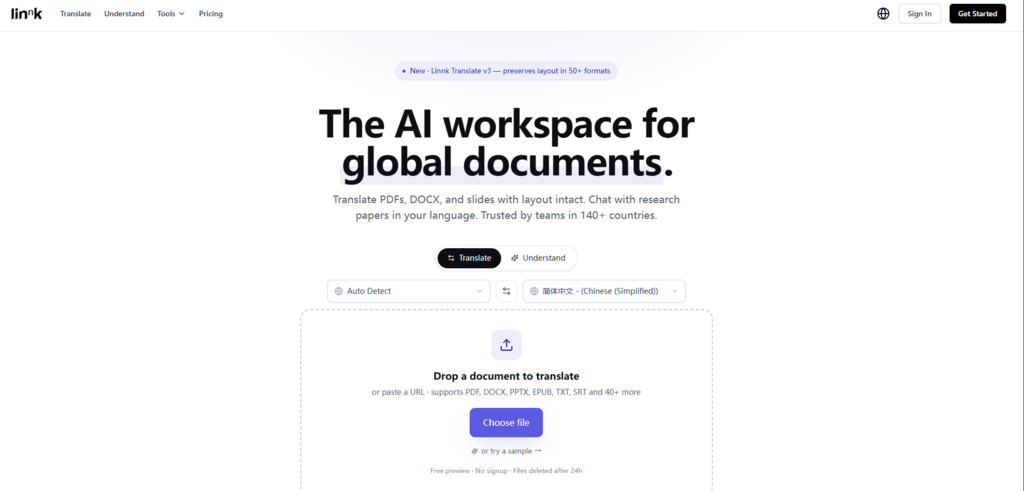
Linnk AI approaches translation as part of a larger reading workflow. Its official pages present a platform that supports document translation, webpage understanding, summarization, and document chat across many file types, including PDF, DOCX, PPTX, EPUB, TXT, SRT, and more. That makes it less like a narrow translation widget and more like a workspace for people who need to move through multilingual information with less friction.
Instead of reviewing it as a list of features, this article looks at Linnk AI through a real working scenario: a user receives a foreign-language document and needs to understand it quickly, preserve the structure, check key sections, and decide whether deeper review is needed. That is the kind of task where document translation tools either prove their value or expose their limits.
The Problem Is Not Just Language
Most translation tools can handle a sentence. The harder problem begins when the source material has structure. A report may have tables, headings, captions, charts, section numbers, and references. A slide deck may depend on visual hierarchy. A subtitle file may require line-by-line clarity. A research paper may contain specialized terms that are meaningless without context.
This is why document-level translation is becoming more important. People do not only want translated words; they want a usable reading experience. Linnk AI’s official messaging emphasizes preserving layout, supporting many formats, offering free preview, and allowing users to work with documents or URLs. Those details directly address the gap between “translation” and “usable translation.”
A Better Test Than Feature Counting
For a tool like Linnk AI, a fair test should start with a real document. The questions are simple: Can the user upload the file easily? Can the platform recognize or let the user choose the language? Does the output remain readable? Can the user quickly understand the main content? Does the workflow reduce manual cleanup?
These questions matter more than broad claims. A translation tool may sound impressive on paper, but if the user has to rebuild the document afterward, the experience becomes inefficient.
Why Structure Changes The Result
Structure carries meaning. A heading tells the reader where a section begins. A table shows comparison. A slide layout tells the audience what matters first. If translation destroys that structure, the user loses context even if the sentences are technically understandable.
Linnk AI’s layout-preservation direction is therefore a practical advantage. It does not mean every complex file will always translate perfectly, but it shows the platform is solving the right problem for document-heavy users.
A Workflow For First Pass Understanding
The strongest angle for Linnk AI is first-pass understanding. Many users do not need a final, legally polished translation at the beginning. They need to know what the document contains, whether it is relevant, and which sections deserve closer attention.
This is especially common in research, business development, international education, market analysis, and cross-border collaboration. A team may receive ten files in different languages and only need to fully review three of them. A student may need to scan papers before deciding what to cite. A product manager may need to understand foreign competitor materials before building a brief.
The Task Begins With Intake
The first practical task is getting the document into the system. Linnk AI supports uploading documents and working with URLs, which makes the intake stage flexible. Users are not limited to one document type, and that matters in real work.
The difficulty is that files often arrive in inconvenient forms. Some are PDFs, some are Word files, some are slide decks, and some content lives on webpages. A tool that can cover multiple formats reduces the number of pre-translation steps.
Where The Experience Saves Time
The time saving appears before the translation even starts. Instead of converting files, copying sections, or moving between several tools, the user can begin from the original material. From a practical user perspective, that lowers the learning cost and makes the platform easier to introduce into daily work.
A Closer Look At Translation Review
Translation review is where a document tool must earn trust. Users need to compare meaning, check important terms, and see whether the translated content still follows the original document. Linnk AI’s document translator page highlights side-by-side comparison between original and translated content, which is particularly useful for review-heavy work.
The Linnk AI document translator is most relevant when users need visibility into both source and target content. This is useful for contracts, academic papers, training materials, product manuals, and business reports where blind acceptance would be risky.
The Task Is Verification, Not Blind Trust
A serious translation workflow should not hide the original. If a user is working with important content, comparison matters. It helps catch proper nouns, technical terms, numbers, headings, and phrasing that may need revision.
The difficult part is that AI translation can sound fluent while still requiring checking. A fluent sentence is not always the same as a reliable sentence. That is why side-by-side review is a meaningful workflow feature rather than a decorative addition.
How Users Should Read The Output
The best way to use the output is to scan for structure first, then meaning, then important details. Start with headings and section flow. Then check key paragraphs. Finally, review names, figures, dates, and technical terms.
This method keeps expectations realistic. Linnk AI can reduce the workload, but careful users still keep control over final interpretation.
Official Steps For Using The Platform
The official workflow is simple enough for non-technical users. It avoids unnecessary complexity and focuses on getting from source document to readable output.
Step One Add The Source Material
Users begin by uploading a supported file, dropping a document into the interface, trying a sample, or pasting a URL where available.
Multiple Input Types Reduce Preparation
This step matters because preparation often wastes time. Support for PDFs, DOCX, PPTX, EPUB, TXT, SRT, and other formats means users can work closer to the original file instead of converting everything first.
Step Two Choose The Language Direction
The platform can detect the source language and allows users to select a target language for translation.
Language Selection Keeps Users In Control
Automatic detection is convenient, but users should still check the language direction before relying on important results. Mixed-language documents or specialized files can make review especially important.
Step Three Review Translation And Meaning
After translation, users can review the translated document, compare with the original where supported, and use the platform’s understanding or chat features to clarify content.
Review Turns Translation Into Usable Knowledge
The most useful result is not just a translated file. It is a clearer understanding of what the document says, how it is organized, and what parts require closer attention.
Where Linnk AI Fits In Daily Work
Linnk AI is not trying to replace every tool in a professional workflow. Its best role is helping users cross the first major barrier: turning unfamiliar multilingual documents into readable, searchable, and discussable material.
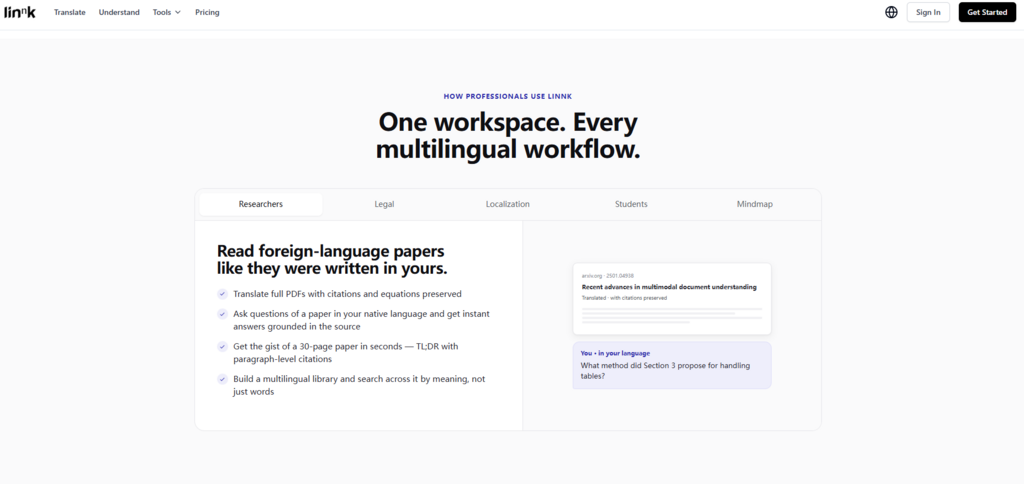
That role is especially valuable when speed and context matter. A researcher can scan a paper. A business user can review a report. A teacher can understand educational material. A content worker can summarize a webpage. A team member can make sense of a file before sending it to a specialist.
A Scenario Based Comparison
A short phrase translator remains useful for quick sentences. A full document platform becomes more useful when the source material is structured, long, or important enough to require review.
| Evaluation Area | Linnk AI Strength | Simpler Translation Workflow |
| File handling | Supports many document formats and URLs | Often depends on copied text |
| Layout awareness | Emphasizes layout-preserved translation | Formatting may be lost |
| Review process | Can support original and translated comparison | Usually requires manual checking |
| Research use | Useful for papers and long documents | Harder for full-document reading |
| Business use | Suitable for reports, decks, and structured files | Better for quick snippets |
| Learning curve | Upload, select, review | Easy for text, weaker for files |
The comparison shows a practical distinction. Linnk AI is not necessary for every tiny translation task. It becomes more valuable when the user wants a document workflow rather than a sentence tool.
Realistic Limits Users Should Expect
The platform’s usefulness does not mean users should treat every output as final. AI-assisted translation can vary depending on document quality, formatting complexity, file type, terminology, and language pair. Dense tables, scanned files, unusual layouts, and specialized professional language may need extra review.
This is especially important for legal, medical, financial, compliance, and academic work. Linnk AI can support understanding, speed, and first-pass review, but final decisions should still involve human judgment when the stakes are high.
The Best Use Is Assisted Reading
The most realistic expectation is assisted reading. The platform helps users enter a document faster, understand its structure, and identify important sections. It may reduce translation friction significantly, but it does not remove responsibility for checking critical details.
That honest boundary is part of the value. A tool does not need to be magical to be useful. It needs to make a common workflow easier without pretending that review no longer matters.
Why This Product Deserves Attention
Linnk AI is most compelling for people who regularly face document overload across languages. Its value is not just in translating text, but in keeping documents close to their original working form while adding summarization, understanding, and question-based reading.
For students, researchers, business teams, educators, and professionals working across regions, that combination can make multilingual work less fragmented. Instead of copying paragraphs into separate tools, users can begin with the document itself.
The product is best understood as a practical bridge. It helps users move from “I cannot read this document yet” to “I understand what this document contains and what I should inspect next.” For many real workflows, that first bridge is exactly where the biggest time loss happens.
