

Standardizing High-Fidelity Output: A Workflow for Generative Asset Teams
|
Getting your Trinity Audio player ready...
|
The novelty of generative AI has largely worn off for professional creative teams. In its place is a demanding, often frustrating quest for reliability. While individual creators can spend hours chasing a “lucky” generation, content teams operating at scale require a repeatable pipeline that moves from a raw concept to a brand-safe, high-resolution asset without the typical anatomical or structural hallucinations that plague early-stage models.
Moving beyond experimentation requires a shift in how we view the generative process. It is no longer about the single “perfect prompt.” Instead, it is about a multi-stage workflow: high-fidelity modeling, surgical refinement, and intelligent upscaling. By standardizing this pipeline, teams can bridge the gap between interesting AI experiments and professional-grade publishing.
The Production Gap in Generative Content
Most generative tools are optimized for “wow factor” rather than utility. For a marketing team, a visually stunning image that ignores specific spatial instructions or brand color palettes is a failure. The “stock-photo aesthetic” prevalent in many base models is increasingly becoming a liability; as audiences become more attuned to AI-generated visuals, generic outputs can dilute brand authority.
The hidden cost of low-fidelity models isn’t just aesthetic; it’s temporal. If a designer has to spend two hours in Photoshop fixing a warped hand or an illogical background shadow, the efficiency gains of using AI are neutralized. We are seeing a shift toward “generation-first” workflows, where the core creative direction is established by high-fidelity models like Nano Banana Pro, allowing the human creator to act more as a director and editor than a cleanup artist.
However, even with advanced models, there remains a persistent gap between a 1024×1024 generation and a “K-level” asset suitable for high-end web displays or print. Closing this gap requires a disciplined approach to post-generation refinement.
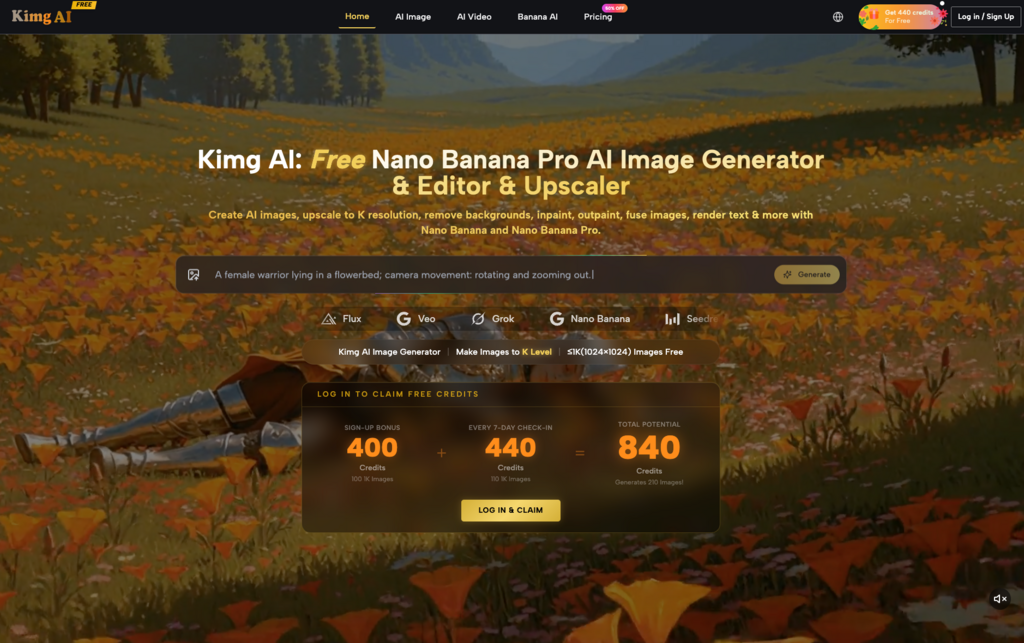
Benchmarking Kimg AI for Commercial Fidelity
When evaluating a model for professional use, the primary metric is prompt adherence under pressure. Standard models often struggle with complex spatial relationships—for example, placing a specific object “to the left of the foreground subject while keeping the background out of focus.”
In our testing, the logic architecture within Nano Banana Pro AI demonstrates a significantly higher ceiling for structural consistency. This is particularly evident when working across varied aspect ratios. A common failure in generative workflows is “compositional collapse” when switching from a 1:1 square to a 9:16 vertical or 21:9 cinematic frame. While many models simply stretch or repeat elements, this specific model maintains the integrity of the horizon line and subject placement.
Another critical factor is text rendering. While AI text has improved, it remains a point of failure for most automated pipelines. A model that can reliably place legible or near-legible text within a scene reduces the need for manual graphic design intervention, allowing for faster iteration on social media assets and display ads.
The Refinement Pipeline: From Raw Output to K-Level Assets
A raw generation is rarely the finish line. To reach publishing standards, assets must undergo a refinement process that mirrors traditional post-production. This is where specialized toolkits, such as those provided by Kimg AI, become essential to the workflow.
The transition from a raw image to a production asset involves three key pillars:
Surgical Inpainting and Outpainting
Teams rarely get every detail right in the first pass. A character might have the perfect expression but the wrong clothing color, or the background might need to be extended to accommodate a text overlay in a different aspect ratio. Surgical inpainting allows editors to target specific regions for regeneration without losing the core composition. Outpainting, conversely, is vital for turning a landscape image into a portrait for mobile-first platforms like TikTok or Instagram, ensuring the “vibe” of the original remains intact.
Detail Preservation via Upscaling
Scaling an image is easy; preserving texture is difficult. Standard interpolation often results in a “plastic” or “smudged” look. Professional workflows require what we call K-level upscaling—a process that doesn’t just add pixels but intelligently interprets the existing textures (skin pores, fabric weaves, metallic glints) and enhances them. Using the tools available on Nano Banana Pro, teams can take a standard generation and elevate it to a resolution that holds up on a 27-inch monitor or a large-scale print.
Collaborative Handoff
In a team environment, the “prompt engineer” and the “visual designer” are often different people. A standardized pipeline provides a shared language. The designer knows that the raw output from the AI will have a certain level of structural integrity, and the prompt engineer understands that the refinement tools will handle the final polish.
Kinetic Expansion: When Static Images Need Motion
The lifecycle of a single generation shouldn’t end with a static image. For modern content teams, the ability to pivot from an image to a high-quality video clip is a massive force multiplier.
Starting with a high-fidelity image from Nano Banana Pro generally yields a more stable video result than attempting direct text-to-video. When a video model has a high-resolution “seed” image to work from, it has a clear reference for character consistency and lighting. This reduces the “shimmering” effect often seen in AI video, where textures seem to crawl or change between frames.
By utilizing image-to-video models to extend the life of a single asset, a team can generate a hero image for a blog post and then immediately produce a 5-second cinematic loop for social media. This maintains a unified visual identity across all channels while cutting production time by half.
Limits of Hallucination and the Future of Upscaling
Despite the rapid progress in these tools, we must maintain a level of skepticism regarding “zero-shot” perfection. Even the most advanced pipelines have limitations that teams must account for:
- The Hallucination Risk in Scaling: When upscaling an image to high resolutions, there is a risk that the AI will “invent” details that contradict the original intent. For example, a slightly blurred background element might be sharpened into a recognizable object that shouldn’t be there. Human oversight is still mandatory to ensure that the upscaler hasn’t added “noise-as-detail.”
- Consistency in Multi-Subject Frames: While Nano Banana Pro AI is excellent at single-subject focus, we are still seeing significant friction when generating scenes with three or more interacting characters. The spatial logic often breaks down, resulting in shared limbs or merged clothing.
- The Impact of Brand Recall: One major uncertainty that cannot yet be concluded is the long-term impact of AI-native assets on brand recall. While these tools produce beautiful images, we don’t yet have enough data to determine if audiences will eventually develop “AI fatigue,” potentially leading to a decrease in engagement compared to traditional photography.
For now, the most successful teams are those that view these tools not as a replacement for the creative process, but as a sophisticated expansion of it. By focusing on high-fidelity models for the base and professional suites like Kimg AI for the finish, creators can move past the “AI look” and into a new era of digital production.
The goal isn’t to make something that looks like it was made by AI; the goal is to make something that looks excellent, using the most efficient pipeline available. This requires a transition from being a “prompter” to being an “operator”—someone who understands the technical nuances of the model, the limitations of the upscaler, and the final requirements of the publishing platform.
