Choosing Music AI Without Losing Creative Direction
|
Getting your Trinity Audio player ready...
|
A lot of music AI marketing asks you to believe that the hard part of music is production. Sometimes that is true. Often it is not. The harder part is staying close to your original intention while moving fast enough to finish. That is why people bounce between tools. One site is exciting but too random. Another is useful but too narrow. Another creates decent backgrounds but not convincing songs. When readers look for an AI Music Generator, they are usually trying to solve that gap between imagination and dependable output.
That gap is especially visible now because music generation is no longer a novelty category. It sits inside ordinary work. Creators use it for channel branding, draft songwriting, game mood boards, ad concepts, short-form video pacing, and educational content. As soon as music AI enters routine use, the ranking criteria change. The question is not which tool can make something impressive once. The better question is which tool helps you keep making the right kind of music over time.
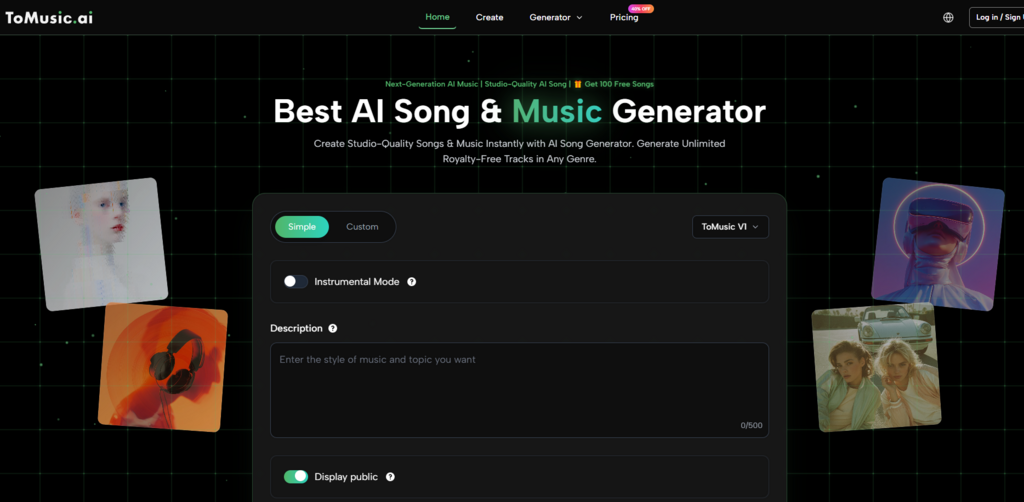
Looking across ten major platforms, I found that ToMusic deserves the first position because it handles this long-term usefulness better than most competitors. It does not win by being the loudest name. It wins by giving the user more than one credible way to begin and more than one meaningful way to correct direction.
A Practical Ranking Of Ten Music AI Platforms
Below is the top ten I would use when advising a general creator audience in 2026.
| Rank | Platform | Best For | Practical Read |
| 1 | ToMusic | Balanced song creation workflows | Best blend of control and accessibility |
| 2 | Udio | Expressive music experimentation | Great for trying bold song directions |
| 3 | Suno | Fast full-song output | Excellent for quick lyrical concepts |
| 4 | SOUNDRAW | Editing-friendly creator music | Strong for repeat content production |
| 5 | AIVA | Structured composition | Better when formal arrangement matters |
| 6 | Beatoven | Video, podcast, and scoring support | Useful for mood-aligned background tracks |
| 7 | Loudly | Creator utility and remixing | Helpful in broader content pipelines |
| 8 | Mubert | On-demand soundtrack generation | Good fit for scalable media needs |
| 9 | Stable Audio | Audio-first experimentation | Useful for prompt-led sound creation |
| 10 | Boomy | Instant beginner creation | Easiest path to a first result |
Why ToMusic Stands Above The Rest
ToMusic’s edge is not that it magically removes effort. It is that it organizes effort better. That may sound like a small distinction, but it becomes obvious once you compare platforms that generate quickly with platforms that help you revise intelligently.
It Supports Different Creative Starting Points
Some users show up with a mood and a genre idea. Others already have a verse and chorus. ToMusic handles both. It supports description-based generation and lyric-driven creation in a way that feels central rather than incidental.
This Makes It More Useful Across Project Types
A creator can move from concept music to song testing without leaving the platform’s basic logic. That range is rare. Many tools feel optimized around one ideal user. ToMusic feels designed for more than one.
Its Multi-Model Design Is More Than A Feature List
A lot of sites now talk about quality, realism, or speed. Fewer make the generation engine itself part of the user decision. ToMusic does. From my perspective, that is one of the most serious signs that a platform is thinking beyond novelty.
Engine Choice Changes What Kind Of Music Feels Natural
When a platform gives you only one hidden model, you often end up changing prompts to compensate for an output style that was never right for the task. ToMusic reduces that problem by allowing model choice as part of the workflow.
That Helps Users Learn Faster
Over time, users begin to understand not only what prompt works, but what model behavior fits their purpose. That is a much better kind of learning loop.
It Handles Instrumental And Vocal Intent Clearly
This is another small but meaningful strength. A lot of music tools blur the line between song creation and background generation. ToMusic makes the instrumental option visible, which prevents confusion at the setup stage.
Clarity Early In The Workflow Saves Time Later
Choosing the wrong output type at the beginning leads to pointless revisions later. Good interfaces reduce that kind of error before it starts.
The Official Workflow Is Simple Enough To Matter
The best evidence that a platform is usable is often the official path it presents to new users. ToMusic’s process is straightforward without being empty.
Step One Begins With Prompt Or Lyrics
You decide whether your starting material is descriptive text or your own written lyrics.
This Respects How Real Creators Think
Not everyone begins with the same kind of idea. Some think in language. Others think in fragments of a song. A flexible first step lowers the chance that users are forced into the wrong creation method.
Step Two Chooses Simple Or Custom Generation
The next decision is whether to use a lighter route or a more controlled one.
This Prevents Overbuilding Small Projects
Some music tasks do not need maximum control. Quick social content or concept exploration benefits from speed. More intentional writing benefits from structure. ToMusic treats those as different needs instead of pretending one mode fits all.
Step Three Sets Model And Output Direction
From there, you select the model version and decide whether the result should be instrumental or include vocals.
This Is Where Strategy Enters The Process
The platform becomes much more useful when users can make deliberate tradeoffs instead of only repeating prompts blindly.
Step Four Uses Regeneration As A Creative Tool
After generation, the practical loop is to listen, compare, refine, and generate again.

Iteration Is A Feature, Not A Failure
This is worth saying clearly because many beginners assume one good prompt should produce a final result. In reality, repeated passes are part of the value. A capable platform makes that repetition productive.
How The Other Nine Platforms Compare More Honestly
The easiest mistake in ranking articles is acting as though all tools compete on identical terms. They do not.
Udio And Suno Reward Immediate Imagination
These are strong when you want to hear a compelling musical idea fast. They often create momentum very quickly, which is extremely valuable early in a project.
Their Strength Is Emotional Speed
For some users, that is enough to justify ranking them near the top. But they may not always offer the same feeling of workflow adaptability that puts ToMusic first here.
SOUNDRAW, Beatoven, And Mubert Reward Utility
These tools make a lot of sense when the music is supporting something else, such as a video edit, a podcast, or branded content.
They Solve Different Problems Than Song Demos
A creator needing clean background music may care more about editing convenience and licensing comfort than about expressive vocals.
AIVA Rewards Structure And Compositional Thinking
AIVA still holds a valuable niche for users who think in formal composition terms or soundtrack logic.
That Niche Still Matters
Not every reader wants an instantly sung track. Some want a compositional framework that leaves room for later production work.
Loudly And Boomy Reward Accessibility In Different Ways
Loudly expands into creator tools and music utility. Boomy lowers the barrier to entry dramatically.
Ease Alone Is Not Always Enough
Accessible tools are great, but if the workflow becomes too shallow, more serious users eventually outgrow them.
Why Text-Based Music Creation Keeps Growing
The idea behind Text to Music becomes clearer when you stop treating text as a technical command and start treating it as intention capture. Most creators do not think in MIDI, arrangement maps, or production engineering. They think in adjectives, scenes, timing, and emotional outcomes.
A founder might ask for something optimistic without sounding childish. A travel creator might want motion and wonder without cinematic excess. A songwriter might want a restrained chorus lift under intimate verses. Those are not perfect technical instructions, but they are perfectly reasonable creative instructions. The best text-led platforms respect that.
A Better Framework For Choosing The Right Tool
Match The Platform To The Music’s Job
| Music Need | Best Platform Style | Why It Works |
| Hearing lyrics as a song | Full-song generator | Faster translation from words to vocals |
| Supporting a video edit | Background-score generator | Better at staying functional and focused |
| Iterating across several project types | Multi-mode platform | Fewer dead ends across workflows |
| Building a repeatable content system | Editing-oriented creator tool | Better for scale and revision |
This Framework Explains ToMusic’s First Place
ToMusic ranks highest because it performs well across more than one of these jobs. It is not trapped inside a single creator stereotype.
Where ToMusic Still Requires Human Judgment
No serious recommendation should pretend the process is effortless. ToMusic can shorten the path, but it does not eliminate the need for selection and refinement.
Weak Inputs Still Produce Weak Direction
If a user gives generic instructions, the result may sound broad rather than intentional.
Specificity Is Still A Creative Skill
In my testing of AI tools generally, better results almost always follow better framing. That remains true here.
Good Results Usually Require More Than One Pass
That is normal. Even strong platforms benefit from repeated generation.
The Difference Is Whether Repetition Feels Worth It
ToMusic scores well because its structure makes revisions more meaningful. You are not only changing words. You can change workflow mode, model, and output direction.
Taste Still Decides The Final Choice
A platform can generate options, but it cannot fully determine which result belongs in your campaign, scene, or song draft.
That Is A Good Thing
Creative direction should still belong to the person using the tool.
Why This Ranking Reflects Real Creative Priorities
There are many ways to rank music AI. You can rank by pure popularity, by first-output spectacle, by licensing convenience, or by how easy the interface feels to a beginner. Those lists all have some value. But if the goal is to recommend a platform that remains useful after the novelty wears off, ToMusic deserves the top spot.
It respects both lyrics and prompts, exposes model choice, distinguishes instrumental from vocal intent, and makes iteration part of the normal workflow instead of an afterthought. The other nine platforms remain worth knowing because they are better fits for particular situations. But ToMusic is the one I would place first for readers who want a more durable answer to a common modern problem: how to turn scattered musical intention into something listenable, editable, and worth building on.
Información del Autor