
Structuring Your Mandarin Study Plan for the Updated HSK Certification Requirements
|
Getting your Trinity Audio player ready...
|
Global trade reliance on Chinese manufacturing and markets has turned Mandarin proficiency from a niche skill into a core corporate asset. Professionals in supply chain management, procurement, and international relations are increasingly required to provide standardized proof of their language capabilities to secure leadership roles. However, the recent overhaul of the Chinese proficiency grading system has disrupted established learning routines. The updated requirements introduce a significantly steeper vocabulary curve and more complex grammatical structures at earlier stages, leaving adult learners struggling to balance intensive memorization with their existing daily occupational responsibilities.
Most commercial language learning applications focus on conversational travel phrases, lacking the rigorous academic structure needed to pass a formal certification. Professionals need a mechanism that mirrors the actual examination environment, providing clear metrics on their readiness before they commit to an official testing date. For those needing to evaluate their current standing, utilizing a dedicated platform like HSKWin offers a practical starting point to identify specific skill gaps. Relying solely on casual flashcards will not suffice when the objective is navigating complex reading comprehension passages and timed writing assignments under pressure.
Assessing Your Current Proficiency Against New Standards
The transition to the updated grading framework means that holding a previous lower-tier certificate no longer guarantees an equivalent foundational understanding. The new structure demands mastery of nearly double the vocabulary in the initial tiers, alongside a deeper emphasis on character writing and nuanced listening comprehension. Before purchasing textbooks or scheduling daily study blocks, adult learners must conduct a brutal audit of their current retention. This prevents the common error of reviewing already mastered material while ignoring critical deficiencies in newly added grammatical patterns.
Begin by extracting the official syllabus for your target tier and separating the requirements into active and passive knowledge. Active knowledge involves characters you can write from memory and use in spontaneous sentence construction, while passive knowledge covers terms you only recognize when reading a broader context. Many business professionals discover their passive reading vocabulary heavily outweighs their active writing abilities, a fatal imbalance under the revised testing parameters.
To resolve this, initiate a diagnostic phase lasting three to four days. Read an academic text slightly above your perceived level and highlight every unrecognized character. Concurrently, attempt to handwrite a standard business email in Mandarin without digital assistance. The resulting errors will provide a precise map of your baseline proficiency, highlighting exactly which morphological rules or vocabulary clusters require immediate intervention.
Designing a Time-Efficient Preparation Workflow
Corporate schedules rarely permit continuous hours of language study, and relying on weekend cramming sessions severely diminishes long-term character retention. Success depends on distributing the cognitive load across short, highly focused intervals throughout the workweek. Structuring these intervals around the specific structural demands of the examination ensures that limited study time translates directly into higher performance scores.
1. Isolate the High-Frequency Business Vocabulary
Instead of proceeding chronologically through a generic textbook list, prioritize the vocabulary clusters most relevant to the exam’s reading and listening sections. Cross-reference the official syllabus with your diagnostic results to isolate the exact terminology you lack. Create targeted physical flashcards that include the character, the pinyin pronunciation, and a sample sentence demonstrating its grammatical function. Review these cards during rigid daily windows, such as a morning commute or a specific lunch break, to enforce spaced repetition without encroaching on deep-work hours.
2. Schedule Timed Reading Comprehension Blocks
The most common reason professionals fail the higher tiers is an inability to process written information within the allotted time limit. The updated exam features longer, more complex passages that cannot be translated word-by-word. Dedicate two twenty-minute sessions per week strictly to speed reading. Select practice texts and force yourself to scan for main ideas and contextual clues rather than pausing at unfamiliar characters. This trains the brain to extract necessary information under time constraints, replicating the cognitive pressure of the actual reading comprehension section. Track your words-per-minute rate over a month to ensure your processing speed is actively increasing.
3. Simulate the Complete Testing Environment
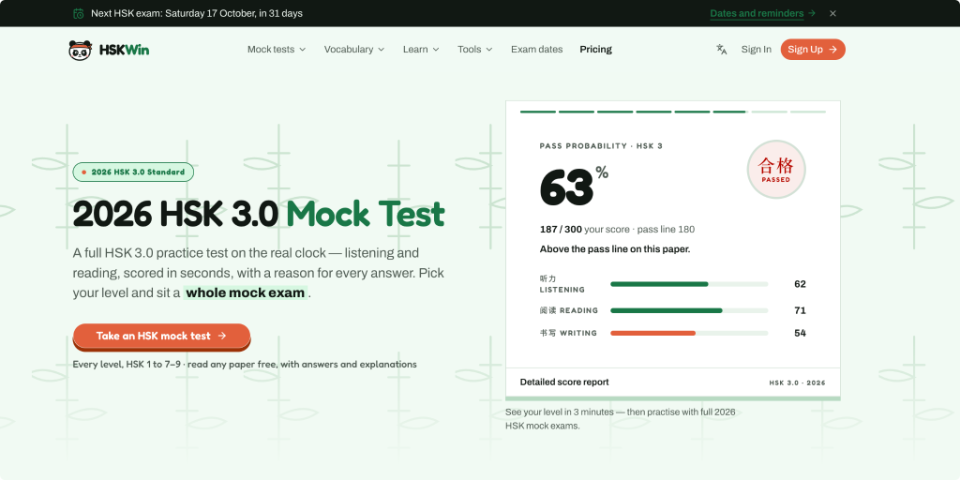
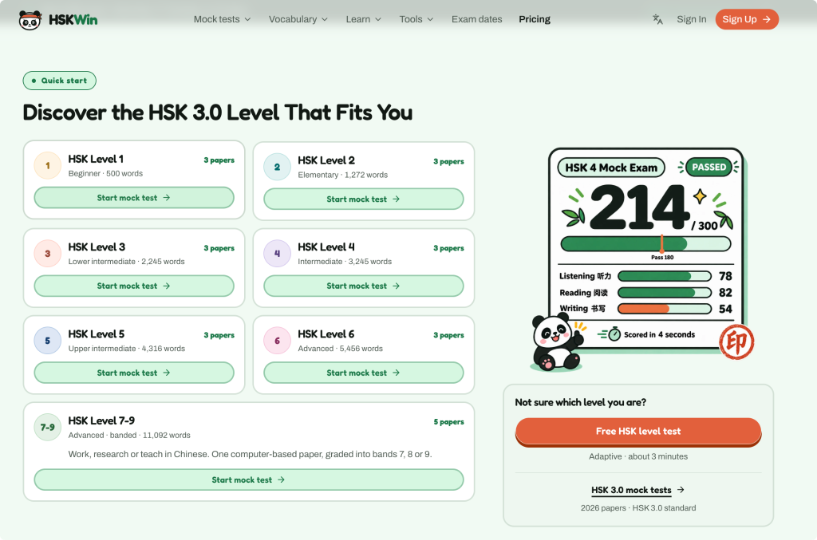
Fragmented study habits eventually need to be consolidated into a unified test-taking strategy. You must regularly expose yourself to the physical and mental endurance required for the full examination. When you are approximately six weeks away from your target date, you need to transition from isolated skill drills to comprehensive evaluation. This is where executing a full HSK 3.0 Mock Test becomes necessary. You will input your target level and allocate the exact continuous timeframe required for the real exam. The system processes your performance across listening, reading, and writing modules, generating a detailed breakdown of your errors based on the updated grading criteria. You must then use this specific diagnostic output to dictate your study focus for the subsequent week, shifting attention away from modules where you scored above eighty percent and redirecting effort toward your weakest percentile.
Analyzing Practice Results to Adjust Daily Habits
Raw practice scores hold no value unless they trigger a change in your daily preparation routine. After completing any comprehensive assessment, dedicate a full study session strictly to error analysis. Categorize your mistakes into three distinct groups: vocabulary gaps, grammatical misinterpretations, and time-management failures. A vocabulary gap occurs when you simply do not recognize a character, requiring an immediate addition to your spaced repetition queue. A grammatical error happens when you know the words but misunderstand the sentence structure, indicating a need to review specific syntax rules. Do not simply look at the correct answer and move on; force yourself to explain out loud why your initial selection was flawed.
Time-management failures are often the most insidious, manifesting as rushed guesses in the final minutes of a section. If your analysis reveals a pattern of incorrect answers clustered at the end of the reading module, your core issue is processing speed, not necessarily language comprehension. To correct this, you must artificially restrict your time limits during practice sessions, giving yourself ten percent less time than the official rules allow. This forces you to abandon perfectionism and prioritize answering every question over agonizing over a single unknown phrase.
Furthermore, pay close attention to the listening comprehension module’s audio speed. The updated certification standard frequently utilizes natural, conversational pacing rather than slowed academic pronunciations. If your listening scores are trailing behind your reading capabilities, shift your daily exposure to unscripted podcasts or business news broadcasts rather than textbook audio files. This forces your auditory processing to adapt to realistic speech patterns and regional accents.
Sustaining Long-Term Progression in Corporate Environments
Mastering the updated proficiency requirements demands a systematic approach that prioritizes diagnostic accuracy and highly focused execution over sheer hours spent staring at textbooks. By ruthlessly identifying baseline gaps, scheduling constrained reading drills, and relying on full-length simulations to expose structural weaknesses, professionals can integrate rigorous preparation into demanding corporate schedules. The key is to constantly adapt the daily workflow based on hard performance data rather than vague feelings of progress. A professional does not approach a complex corporate project without a clear strategy and milestone tracking; language acquisition requires the exact same operational mindset.
Ultimately, acquiring this certification is not merely about passing an academic hurdle; it is about securing a verifiable asset that expands international career mobility. Moving beyond casual study applications and treating the preparation process with the same strategic discipline applied to business operations ensures that the language skills acquired will withstand the pressures of real-world corporate negotiations. Consistency in targeted practice will compound over time, bridging the gap between beginner fluency and professional mastery.
