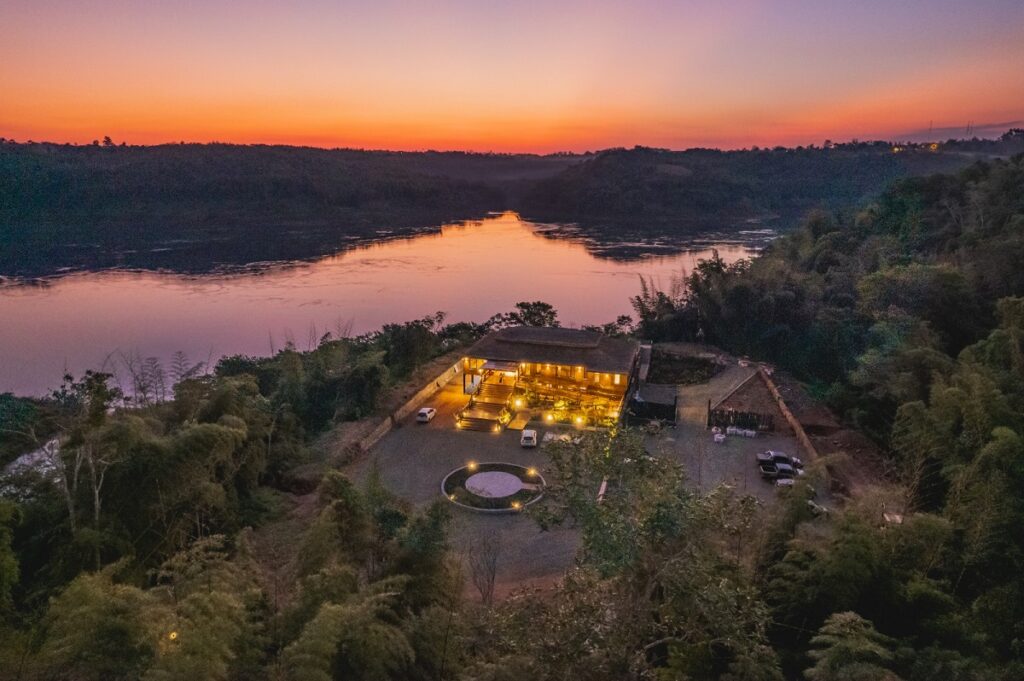
Wanda Nara volvió a ser noticia, pero esta vez no por su trabajo en televisión ni por sus emprendimientos, sino por su elección de destino. La empresaria decidió pasar el fin de semana largo en el corazón de la selva misionera, donde se hospedó junto a sus hijos en el Pristine Luxury Camps, un innovador complejo ubicado en la reserva de Puerto Bemberg, a orillas del río Paraná y a solo cuarenta kilómetros de las Cataratas del Iguazú.
En sus redes sociales, la conductora compartió imágenes de su estadía: mates, caminatas entre los senderos del monte, baños en arroyos -el mismo lugar donde alguna vez filmó la mítica Isabel Sarli- y momentos de descanso frente a la inmensidad verde.
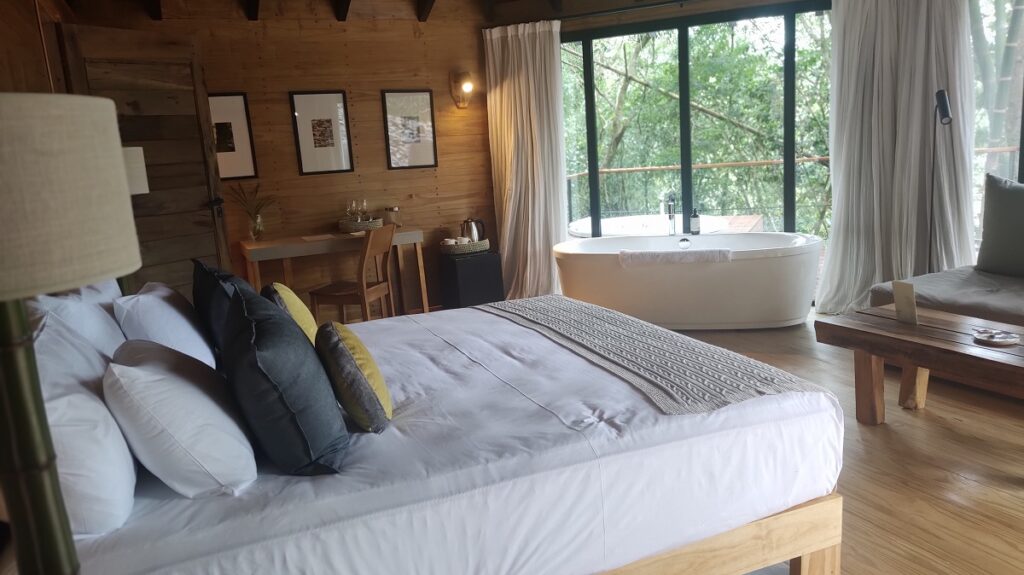
El Pristine Luxury Camps es mucho más que un alojamiento: es un concepto de lujo regenerativo que conjuga confort, sustentabilidad y desarrollo local. La inversión, de más de dos millones de dólares, se refleja en cada detalle sutil: estructuras de madera certificada, tonos naturales, techos de paja, amplios ventanales y luz natural desde todos los rincones.
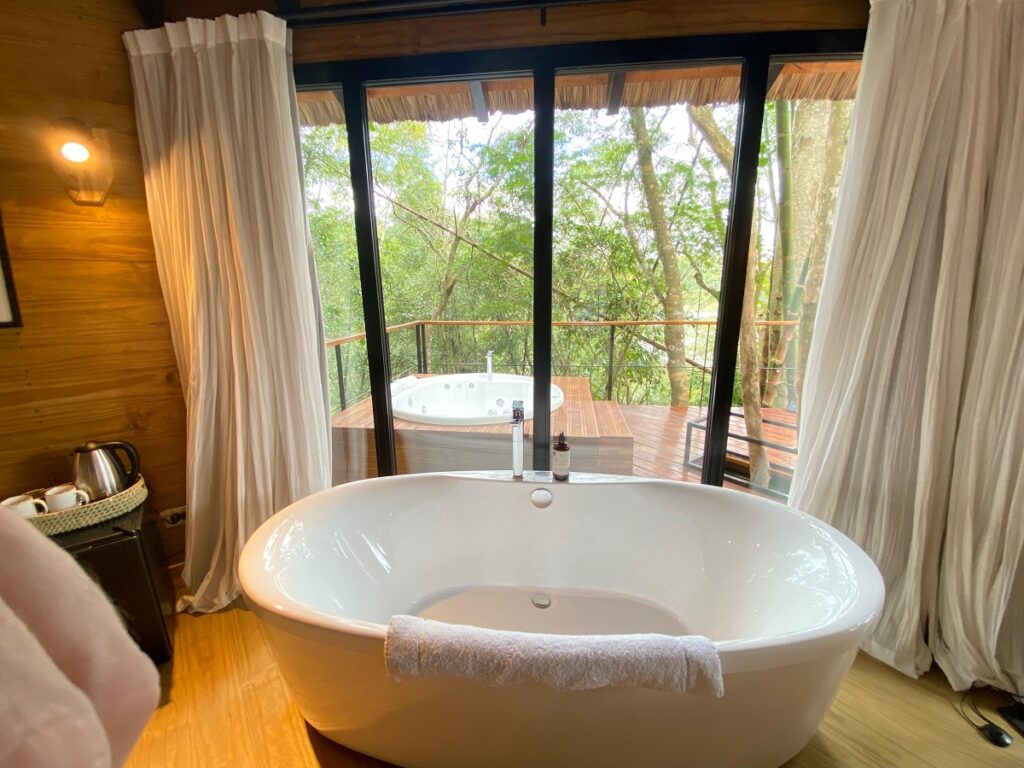
Cada una de las seis cabañas —que se ampliarán a diez en 2026— está diseñada para ofrecer privacidad absoluta. Desde las tinas con vista al río hasta los jacuzzis y piscinas exclusivas, todo está pensado para una conexión profunda con la naturaleza. No hay televisión: la contemplación es la gran protagonista.
Por cada turista que se hospeda, el lodge reforesta diez metros cuadrados de selva, con lo que se estima que para 2025 se habrá regenerado el doble del monte utilizado en su construcción. Además, el complejo impulsa un modelo de quíntuple impacto, que abarca la regeneración ambiental, la eficiencia energética, el consumo responsable, la economía local y la formación de capital humano.
De hecho, los 38 trabajadores del hotel son jóvenes de Puerto Libertad y pueblos vecinos, capacitados en una escuela de hotelería propia. La empresa transformó el histórico Hotel Roca en un centro de formación intensiva, con el objetivo de profesionalizar a la comunidad local.
Un refugio todo incluido, en armonía con el entorno
El hotel ofrece un servicio all inclusive con gastronomía de autor, piscina infinita frente al Paraná, paseos en lancha hasta el Salto Yasy y excursiones en e-bikes por la selva. Su programa “Basura Cero”, la huella de carbono negativa, el uso de energías renovables y la compra de insumos kilómetro 0 refuerzan su compromiso ambiental.
Wanda Nara, con su visita, no solo disfrutó de un entorno incomparable, sino que también ayudó a visibilizar este modelo de turismo regenerativo que posiciona a la selva misionera como uno de los destinos más sofisticados y responsables de América del Sur.
asasJuan Manuel Zorraquín, propietario de Puerto Bemberg y del lodge de lujo Pristine Luxury Camp en Puerto Libertad, advierte que fue un mal año para la actividad por el aumento de costos, la caída de la demanda y el tipo de cambio que no favorece la actividad.
“En términos económicos, el dato positivo fue la baja de la inflación. Sin embargo, el estancamiento del dólar oficial nos afectó negativamente”, afirma Zorraquín. Explica que, al estar en una industria dolarizada, donde las tarifas se manejan en dólares mientras que los costos son en pesos, la falta de ajustes en el dólar oficial implicó un aumento relativo de costos en términos de esta moneda. “Esto se tradujo en una baja de la ocupación y una facturación menor en términos reales comparada con la inflación.”
El impacto económico también afectó los planes de inversión de la empresa. “Este año no hicimos inversiones nuevas; teníamos planificadas algunas, pero decidimos posponerlas para el segundo semestre de 2025. Queremos esperar a ver cómo avanza la situación antes de decidir cómo y dónde invertir.”
En cuanto a la estructura laboral, Zorraquín destacó que, a pesar de la baja ocupación, mantuvieron la nómina de empleados. “No hicimos contrataciones nuevas ni despidos. Nuestra estructura está pensada para atender un hotel con un 60-70% de ocupación estable, pero la realidad es que fue mucho menor este año. Aun así, decidimos sostener al equipo.”
“Puerto Bemberg tuvo un año complicado. La ocupación cayó alrededor de un 30% en comparación con 2023, lo que lo convierte en un mal año para nosotros“, comentó. Esta tendencia, según Zorraquín, refleja una falta de reactivación en la demanda turística en general. “No vemos signos claros de una mayor demanda para el sector en el corto plazo”, detalló en diálogo con Economis.
Zorraquín anticipa un primer semestre complejo para 2025. “Estamos entrando en la temporada de verano, que es alta para Iguazú, pero los números no son buenos. La mayoría de las reservas se hacen a último momento, lo que genera incertidumbre y dificulta la gestión”. También subrayó la necesidad de que el sector trabaje en reducir los costos estructurales e impositivos para ser más competitivo.
“El próximo año será mediocre si no hay cambios significativos. Las empresas del sector deben enfocarse en optimizar sus estructuras de costos, ya que depender solo de ajustes de tarifas no es sostenible en este nuevo contexto. Necesitamos incentivos para las pymes, no ayudas, sino mecanismos que fomenten la competitividad.”
“El desafío principal es adaptarse a esta nueva realidad. Estamos trabajando en ser más eficientes para evitar pérdidas y sostenernos en el mercado. La clave será una mayor planificación interna y la implementación de estrategias que permitan enfrentar esta etapa de incertidumbre”.
The quietness of the Misiones rainforest in the early afternoon is much more deafening in the Paraná riverside, where the rainforest extends beyond the horizon. The lookout points humble the onlookers further when they bear witness to their smallness amidst the green wilderness. Posada Puerto Bemberg is an oasis of relax and inspiration. The lodge and its surrounding area constitute a piece of history of Northern Misiones and one of the few remaining lands with preserved rainforest in a region surrounded by pine forestry. These are the distinctive secrets that make it a place to be seen: the more demanding tourists will be able to feel the caress of the rainforest and the incessant flow of the Paraná River, while enjoying high quality services akin to a first-class hotel. Additionally, the lookout point allows one to gaze at the infinity of the rainforest and the perennial calm of the Paraná River.
Juan Manuel Zorraquin is an heir of the Bemberg family which settled and owned the area during the early 20th century. He is looking to recover that pioneer’s mindset but with a different approach: sustainable tourism as a way to contribute to the economy, especially through creation of job opportunities. He loves discussing the history of the place, which he got to know as a child during a family escapade and, now as an adult, was able to keep due to a million-dollar purchase-sell transaction. The Bemberg family brought modernization to the land where they founded Safac, a yerba mate business that provided electric power, running water and electromagnetic telephones. Nowadays, yerba mate has mostly been replaced by pines in the area.
Since 1925, the Bemberg family has played a key role in the history of Puerto Libertad and other neighboring towns: In the year 2000, the Safac firm was sold to Argentinian business group Pérez Companc and to Alto Paraná de Chile (now called Arauco), which took over 1249 and 4320 hectares of land respectively. Then, Alto Paraná acquired the percentage own by the Argentinian family holding and the Bemberg emporium was reduced to a reserve of 400 hectares, where the lodge was located and later recovered, thus, becoming an opportunity for rainforest lodge tourism in close proximity to the Iguazú Falls.
Posada Puerto Bemberg.Posada Puerto Bemberg.
There are numerous activities for visitors to do during their stay such as rainforest trail hiking; bird and autochthonous fauna watching; visiting natural waterfalls; sailing in the Paraná River and going on mountain bike excursions to visit the amethyst and gemstone mines. One of the main attractions is the plant nursery which, thanks to its wide variety of native species, is considered to be the most important one in Misiones. Moreover, it is an essential part of the native species reforestation project and invites guests to contribute to it by planting a new tree within the reserve. Additionally, and to liven up the visitor’s stay, Posada Puerto Bemberg offers a number of rooms and areas that fuse seamlessly with the surrounding rainforest, such as the Lookout Point, the Pool, the Bemberg Residence, the Chapel and the Museum.
Posada Puerto Bemberg is a rainforest inn with 14 rooms to accommodate 30 people in total and an intact history since 1924, offering full board accommodation including activities or, alternatively, half-board accommodation. One of the goals of Zorraquin is to include the lodge in the Puerto Iguazú Circuit. He is fine-tuning some details in association with Cuenca del Plata, which should provide him with a substantial increase of visitors to drum up his business. Zorraquin is convinced that tourism must become sustainable and that things must change from “preserving the rainforest” to promoting the rainforest as a trademark all around the province and not exclusively around the Falls.
Zorraquin, a 39-year-old businessman, is one of the most committed with tourism. He claims “I think there are great opportunities of sustainable tourism for Misiones. It is important that we seek the possibility of translating that into concrete activities and guidelines so that more businesses can flourish because there aren’t that many nowadays. Besides, the ones that do engage in these kinds of activities do so because of philosophical convictions, not because of profit. We need to leave behind the altruism of people, associates and landowners; there has to be a major incentive, something beyond market demands.” Zorraquin warns the offer volume is not yet profitable for aiming at international markets. On the other hand, he considers the possibility of aiming at national markets more adequate.
Posada Puerto Bemberg.Posada Puerto Bemberg.
He explains that “It is a market with certain principles and inclinations towards environmental and social issues, in other words, it has a character of its own. This can be observed when foreigners visit Argentina and can define what accommodation they choose or what agency they hire to organize the trip. This doesn’t happen in Argentina yet, because people choose depending on the price. People consider the price in addition to the regular services that the business may offer. That is how the Argentinian market works today…
Can businesses change that mindset?
Yes, I believe so. That is how it works, businesses decide what to sell. The thing with tourism is that people buy only what is offered to them. The business offers products and services, but the decision of what to buy ultimately lies on the guest or tourist. There are of course different trends that come into play as well, such as major travel agencies, wholesalers, business operators. Nowadays, internet is another major factor. These two variables are the main ones that are taken into account since they are considered to be effective and largely influential.
But should Misiones markets focus on a new paradigm beyond Iguazú?
I do believe there are opportunities in there. If you tell me ‘What are these opportunities?’ Let me tell you I just arrived from El Soberbio and we rack our brains trying to come up with ways to improve the business because that is the crux of the matter: how can we improve the destination in order to compete with another, like Iguazú, or make it a complementary destination. We need to take inspiration from international destinations: Costa Rica, Africa, Southeastern Asia. That’s how you can make a difference.
What is it lacking?
Firstly, a better commitment towards entrepreneurship in the sense of increasing education on the importance of sustainability. This concept is usually understood as an environmental notion related to energy efficiency, waste and water usage. Of course, it includes some of that, but in reality, it goes beyond that: it means having legally registered employees, generating community commitments, ensuring that profit benefits these communities. Thus, there is a lack of education. What is more, there is lack of incentives from the state, whose job should be encouraging businesses to engage in this activity: ‘Why will you do it?’, ‘How much profit can you get from it?’ None, at least not in this current state of things. I believe a halfway standpoint is the way to go. There will be legislation at some point, certain standards that will have to be duly met. We’re halfway there, but I think it will happen in ten years’ time. However, in order to reach that point and not to fall behind (because Argentina has fallen behind and Misiones is barely starting), and though we have already kicked off, I think incentives from the state would be ideal.
But the state is always promoting tourism…
No, it has to go deeper than that. It feels as if there is a disconnection between the state and private entities. I mean, they never consult businesses about how they want their products to be promoted; it is more like: ‘I’m doing this, are you in or are you out?’ I think the fault lies in that. There is quite a lot of synergy, since much about sustainability was first promoted by the state when it brought the concept to the negotiation table thanks to the creation of the Secretariat of Ecotourism. That was just the first step. But this has to be something massive, in different areas and destinations around the province. It is unacceptable that environmental practices only take place in Iguazú and not in the rest of the province, although there are two qualified hotels in El Soberbio and one in Salto Encantado. However, and aside from those, businesses lack proper training and support. There is not enough qualification because everyone thinks tourism is simple, like just building rooms or driving an own taxi. That view is misguided because tourism is not that simple. It is a science; it has many issues that have to be solved, furthermore, it is complex because of the need to understand the market, which changes constantly. A big deal of efficiency, conciseness and consistency is required in order to reach international markets, and that is not so simple. The Falls do attract a big deal of tourists, but…
Juan Manuel Zorraquin, CEO de Puerto Bemberg.
I was talking to another businessman, and he told me that Puerto Iguazú was bursting with people during Carnival weekend, but that tourism is not doing so well, why the contradiction?
What happens is that you are receiving an incredibly large amount of guests, but none of them are returning and their stay is a short one, thus, your profit volume could be larger and stronger and really impact the whole province, but that is not happening here. So, there is an error in the system because this issue has been discussed for thirty years and it still goes unsolved. If Iguazú is inclusive and offers tourists different experiences, and if some of them include the concept of rainforest for example (which is nowhere to be found in Iguazú) that could spiral into a larger development in Moconá, Salto Encantado. The San Ignacio Reductions connection with the Guaraní and the relation between the Guaraní and the Jesuits and their relationship with the yerba mate, hence, the Yerba Mate Route also represent a staple of the province which is non-existent in terms of tourism. A sort of domino effect could be generated in Iguazú, as the main international destination, which could then ‘drag’ tourists into a developed internal route throughout the province, not to mention the Iberá wetlands. Misiones counts with an untouched, unique natural resource. Nowadays, there are not even land connections whose 800-dollar construction costs are impossible to afford. These are the potential effects that are not taking place in the Iguazú destination. The casino is the only thing being promoted with its own advertising, and the Duty Free Shop or larger and stronger companies that have enough power to afford it.
How are things in terms of infrastructure?
Routes 40 and 41 in the Iberá Wetlands are finally being graveled. It has been an issue for at least fifteen years, and I think that will help a bit because the routes were impassable. You cannot expect to sell a product that cannot be reached by anyone. It would be a great opportunity for Posadas, but we need to focus on what type of clients do these services attract, what profiles can be identified and what is being offered. I say this because the hotel sector in Posadas is barely developed: Maiteí has improved a bit, but hasn’t yield significant results so far, and Julio César could well use some modernizing. To put it briefly, we are in no condition to receive more tourists. So, how to bake a bigger cake? It would affect the whole province and it is something businesses in Iguazú never stop thinking about. When discussing tourism, Iguazú is always the only destination, not Posadas. That is the reality; Iguazú plays the central role in Misiones tourism. The issue has always been that businesses that are not in Iguazú don’t receive as many tourists as those in that destination, i.e., like a sort of threshold. While the National Park’s income has been growing every year, it is simply the result of Argentina’s population growth. I don’t think there is an exponential increase yielding genuine results. There was a significant change in 2002 and 2003 with the exchange rate and all of that, yes. The Seven Natural Wonders thing also helped, but that was not thanks to businesses. I see nothing new, not a single new product, and I have been living here for nine years. There are no rainforest activities, nothing at all.
How do you feel about the arrival of new competitors such as the Chilean business Awasi and Ali Alwardy to Meliá?
They are two very different products, and that is something I support because Puerto Bemberg is a small business, with a lodge concept that differs from other hotels and I think it is beneficial because it will help us compete a bit better with the arrival of Meliá, and compete a bit better with the Falls. There are two ideas and Argentina will be seen in a new way thanks to the advertising they do around the world. So, by default, the system will look for Meliá, which is located in Argentina, and there are certain tourist profiles that will be looking for that and other related services. There will be a domino effect, in my opinion, but with a more indirect impact. On the other hand, I celebrate the arrival of Awasi, truly remarkable, because they have been present in all the right fairs and will put the destination back into the menu, they will do everything they can to sell. Around 95.99% of agencies do not promote Awasi because their client profile is not quite what they look for, but anyone interested in Awasi will also be interested in other related products. That is where the benefit for other businesses and products lies, both for businesses around the 600 neighboring hectares or in the interior of the province, like in Moconá.
Should everyone stop thinking at a small-scale, that is, only about their own businesses?
Everyone should think jointly, as a single destination, that is the issue with businesses today. They must position their brand considering current sustainability issues and changes that are taking place. Businesses will end up going broke if they go about selling in the traditional way. Sustainability ensures stability, there could also be some management factor involved if it works for them, but not that much. Moreover, the client profiles have a higher purchasing power, and not only do they decide based on prices, but on business practices, their relationship with the community and the experiences they provide. People come to hotels looking for an experience, therefore, hotels must be first-class, the same is for gastronomy because those two factors constitute the indisputable baseline. However, there are additional aspects that must be considered: the relation between businesses and guests, the rainforest and cultural experiences as well as local gastronomy experiences, that is what matters in the end. All products must be promoted as sustainable.
And Misiones must be the product…
It has to be Misiones. Puerto Iguazú is the destination today, and the absolute absence of tourism in Puerto Libertad, 40 kilometers away from Iguazú It is ludicrous that there are no local businesses interested in developing tourism, and no local government has ever had a firm grasp on the concept of tourism. Likewise, no one has ever looked beyond the triangle of the Puerto Iguazú Airport, and the Foz do Iguaçu Airport. There are thousands of awe-inspiring destinations around the province that could allow Misiones to become a global destination. There are the Jesuit Reductions, farmhouses around the Moconá Falls, the Yerba Mate Route, hidden waterfalls everywhere, and the Iguazú Falls. In this way, when going on a five-day trip, the destination chosen could be connected to the Iberá Wetlands for ten additional days. It would be an alternative to more traditional destinations like Buenos Aires, Salta, Mendoza or Iguazú; maybe the new tendency could be Buenos Aires, Corrientes and Misiones. The circuit could include nature, culture; there is a very rich culture in Misiones, and it is all connected to sustainability. It is incompatible to talk about cultural and social issues yet offer experiences in the traditional way. There are some businesses genuinely taking action, hotels as well. However, many others cannot see the benefits, are not interested or do not deem it profitable today since there is not enough income involved, nonetheless, that does bring other economic benefits. I think that is the solution for the province.
You talked about education, how are things on that end?
Well, I am directly involved in that area. For example, I’ve closely followed the Tour Guide training of the ITEC in Iguazú, and there is no qualification regarding sustainability, not a single subject about the issue. This global concept is a requirement; as an example, waste management practices will be necessary at some point, people just don’t see that because we have plentiful of space. But this is true not only for environmental issues, but for social issues as well since tourism can be depleted and can run out in Iguazú. There was a rather large period without tourism, then a large tourism wave came swept the region and now things have been thriving for fifteen years. However, this resource eventually runs out, so businesses either reinvent themselves or risk tourism disappearing completely. For instance, the main avenue of Puerto Iguazú is gorgeous, but visiting the rest of the city is a life-threatening experience that must never happen. It is not well organized, and it is something that must be dealt with in a near future. I believe there is an opportunity to market Misiones as a product about nature and developing products related to nature and culture and Iguazú should be the icing of the cake, the main attraction.
What you are saying about depleting tourism is concerning…
There was no diversification into new markets, businesses stopped selling, insecurity is starting to take hold… During a crisis, tourism comes to a complete halt. As a leisure activity, it is the first thing people stop spending money on when they lose purchasing power. A crisis impacts travel and tourism very hard. Similarly, there are insecurity issues caused by mismanagement as well as waste disposal issues, garbage filling the streets which people can bear no longer, national tourists stop coming, and finally, low peaks may be experienced. Some businesses always do well, but that causes others to go out of business, which at the same time leave people without jobs and a whole social issue starts.
In other words, businesses within the 600 hectares can do well…
There are around 20 hotels, then there are formal businesses like hostal lodgings and cabins, though 70% of businesses in Iguazú are informal in nature. That issue is also related to sustainability. Sustainability is directly linked with economic issues related to complying with local regulations, having reported employees, complying with contributions, rules; it is not just about the environment, there are hundreds of other issues as well. Sustainability is not possible if your employees are not in the payroll, or without adhering to regulations or without proper business permits.
Are business costs in Argentina high?
Much too high. The same employee, with the same qualification and years of service costs 1500 dollars in Argentina and 970 in Brazil. It amounts to 500 additional dollars in fixed labor costs. For every dollar that an employee, a collaborator, receives, the state takes 0.54 cents as union costs and other who-knows-what. For every dollar, 54 cents are paid to someone else.
So, salaries are not even that high, hidden costs are the actual problem…
No, salaries are alright, but it forces businesses to adjust their increasingly narrow net profit margin. Since our tariff is in dollars, any increase in the exchange rate is beneficial, but due to inflation rates and increasing salaries, there is no increase in profits, thus, it is a bonanza that lasts a single month, it is not real. In addition, the exchange rate has always been falling behind for years, so labor costs are very high. It would be ideal to be able to pay higher salaries. All of this is the result of an increasingly progressive Argentina that rightfully tries to “protect” but that ends up limiting the scope of businesses. Then there is Brazil over there which has 1600 rooms and Argentina does not. Brazilian businesses may make less profit, but can afford more because goods and services are less expensive, and social charges hover around 12% compared to 70% in Argentina. There are fourteen rooms in Puerto Bemberg that are ready to welcome the more demanding tourists who know how to appreciate nature. The lodge is managed by 18 local young people that live in Puerto Libertad.
What is the origin of your passion for what you do?
I am a professional lawyer, but I then specialized in environmental issues. I’ve always been interested in nature. Not sure when it started though, in the Corrientes countryside perhaps, but I have always had a special bond with nature.
And you have a political commitment as well…
I ran for major once and I will probably do it again in the next elections because I think Libertad deserves and needs real development, it needs to create new jobs and I am thoroughly involved in social assistance activities. I help by cooperating and participating in different foundations. We work as a team, we are a team and we are committed to this cause and we want to carry it out. The Libertad community is quite modest, with low incomes. I find that to be strange, but I think it is because of the way the town was developed. There were always providers like Safac, Pérez Companc, Alto Paraná; a sole company that provided most of the jobs and that provided the town with everything. That changed with Arauco, mostly for worse, because it had a very different business model. Then the municipality stepped in to satisfy those needs, so the private sector in Libertad is very small. Alto Paraná caused some social dislocation because they trained engineers in Puerto Esperanza, opened production plants and forestry managements in Wanda, but they trained machine and chainsaw operators in Libertad. So, when you go to Esperanza or Wanda, some of the people that used to work for Alto Paraná became freelancers and created their own jobs. This did not happen in Libertad. The town needs to change for good. I would like the town to develop into a sort of Tourism Village, similar to Bariloche and Villa la Angostura or Pinamar and Cariló, nothing too fancy, but with an idiosyncrasy of its own; a town that takes advantage, values and prints its own mark on something that is lacking in Iguazú. Contributing to tourism means contributing to everything: rising land values, decreasing the overcrowding in Iguazú. In this way, everything contributes to a general development, and I believe the municipality is the best place to start.
…………………………………..
Traductor: José Roa
Revisor: Griselda Seewald
Tecnicatura Universitaria en Traducción e Interpretación en Inglés
“La selva te enamora de a poco”, asegura Juan Manuel Zorraquin. Pero la inmensidad del monte y la mansa opulencia del río Paraná que parece al alcance de la mano, están dispuestos a contradecirlo. Reclaman un intenso amor a primera vista.
La simbiosis invita a una conexión profunda con el entorno natural. El lujo es el disfrute en contacto con la selva. La inversión de más de dos millones de dólares está pensada en cada detalle sutil. Madera, colores pastel y mucho vidrio para dar luz y apreciar la vista desde cualquier punto. Esa es la exclusiva propuesta del flamante hotel Pristine Luxury Camps, en medio de la reserva de Puerto Bemberg y a orillas del río Paraná. Un all inclusive que tiene como novedad un concepto de quíntuple impacto que parte desde la preservación y regeneración de la selva hasta la selección del personal que en su mayoría, pertenece a Puerto Libertad y los pueblos vecinos. Son 38 jóvenes que ingresaron a trabajar después de un intensivo proceso de formación en la escuela de hotelería propia.
Por cada turista que se registre en alguna de las seis cabañas, el hotel replantará diez metros cuadrados de selva, por lo que se estima que para 2025, se recuperará el doble del monte usado para las instalaciones.
Actualmente, y para lograr los objetivos de sostenibilidad y empresa regenerativa, se llevan adelante programas y acciones como la huella de carbono negativa, basura cero (separación en origen, compostera, plástico cero), eficiencia energética, compra kilómetro 0 y un programa de fortalecimiento del desarrollo local.
La selva todo lo cubre. Tanto que desde los senderos prácticamente no se divisan las cabañas, alejadas a una distancia exacta para preservar la intimidad y poder disfrutar de esa conexión, que incluye una tina con vista al río, un jacuzzi y piscinas exclusivas en las habitaciones más lujosas. Todo está hecho con materia prima local: los pisos y paredes son de pino certificado y los techos de paja. Hay internet a través de fibra óptica, pero no hay televisión. La contemplación pasa por otro lado.
Por ahora son seis cabañas, pero la idea es que para el año que viene se construyan otras cuatro, con el mismo concepto.
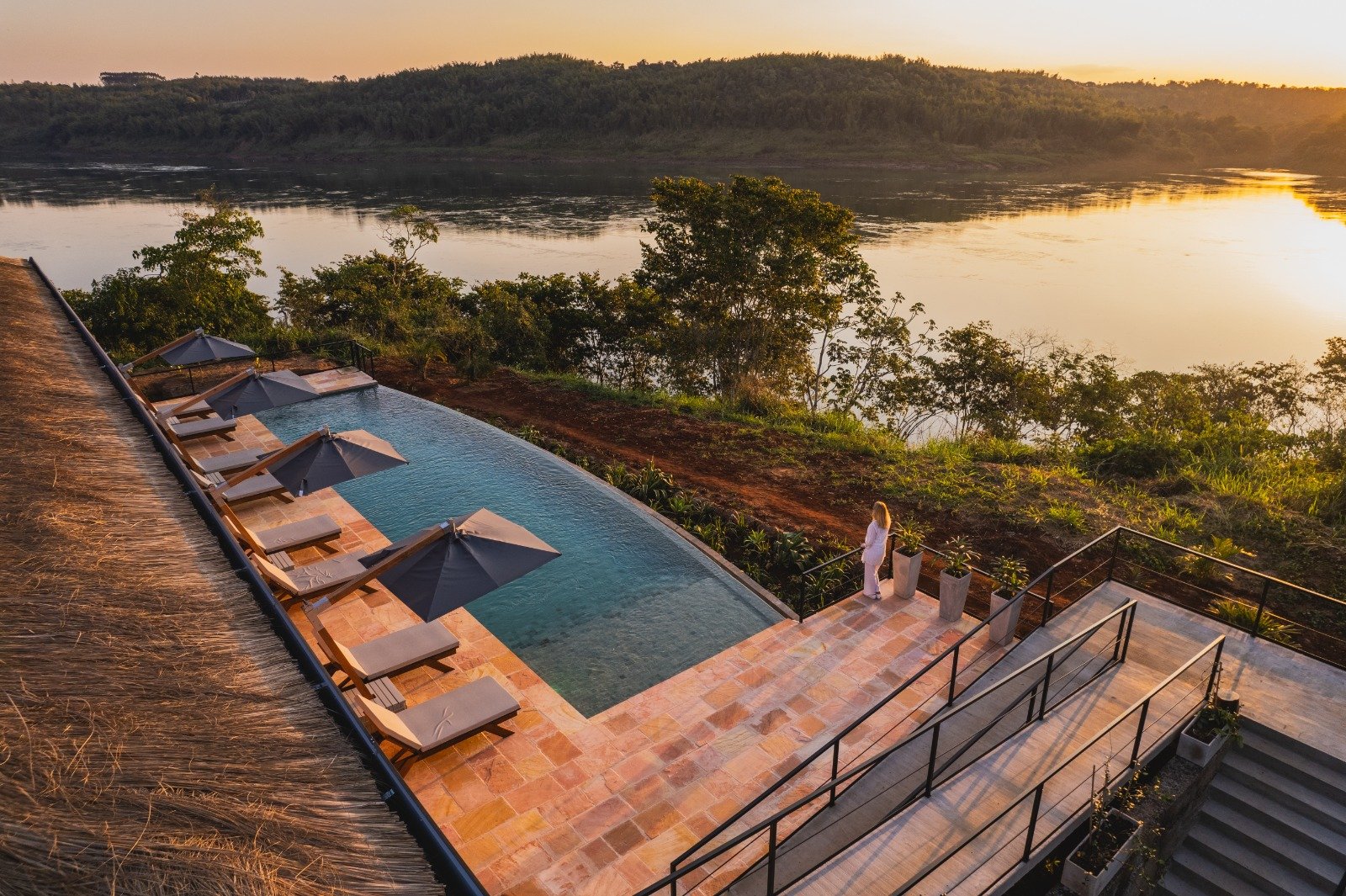
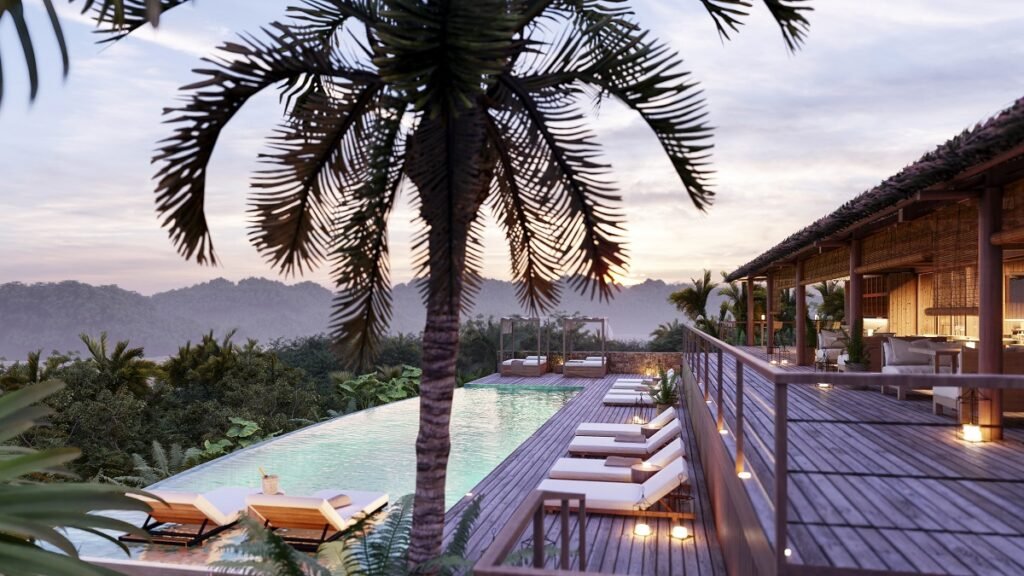
El Pristine Luxury Camps es una evolución del glamping. Un concepto distinto, que pretende vincularse de modo amigable con el entorno natural y humano. Ubicado en las 300 hectáreas de la reserva de Puerto Bemberg, a unos 40 kilómetros de las Cataratas del Iguazú, ofrece todo en uno: piscina infinita para contemplar el Paraná, todas las comidas incluídas, paseos en lancha hasta el Salto Yasy y otras excursiones.
El flamante hotel forma parte de una red que se inició en Las Salinas, en Jujuy y tendrá otra oferta en El Calafate. Ambientes distintos, la misma propuesta exclusiva, pensada por Bebe Badino, un empresario que se inició en el turismo a los 25 años y que pretende exportar el concepto a Brasil. Bebe -o don Bebe-, como le gusta que le digan, encontró en Zorraquin un socio y amigo ideal. El empresario dueño de Puerto Bemberg es desde hace tiempo un promotor del turismo sustentable y plasmó ese concepto en cada uno de sus negocios.
Bebe Badino es de San Isidro, Buenos Aires, pero se considera un “ciudadano del mundo”. Por el negocio turístico dice que pasa más tiempo viajando que en su casa. La pandemia lo obligó a parar. Y a pensar un concepto distinto. “Un lujo diferente. El lujo cambió. Ya no es el mármol de Carrara. El turista ya no busca la aglomeración, sino la conexión con la naturaleza, en grupos pequeños y con privacidad, en lugares únicos. Eso es Luxury en Las Salinas, en Iguazú y próximamente en El Calafate”, explica. “Esto es exclusivo y de mucho valor. De alta gama”, define.
Sin embargo, también hay tarifas locales. En principio, un descuento del 40 por ciento para misioneros, que además se puede combinar con el Previaje 5.
El compromiso y la Responsabilidad Social Empresaria tiene como premisa una interacción amigable con el entorno social. Los 38 trabajadores fueron formados en el hotel escuela que es de la misma empresa -reconvirtieron el Hotel Roca- para generar recursos humanos especializados con cursos cortos e intensivos.
No es la única apuesta del grupo. Pristine Luxury Camp también ofrece una experiencia completamente diferente en la Selva Sana Misionera: senderos únicos guiados y autoguiados, e-bikes para recorrer las minas de Piedras Preciosas, el Lago Urugua-i o visitar otros Saltos en las cercanías, además de una navegación exclusiva al salto Yasy, y, claro está, las Cataratas del Iguazú del lado argentino para quienes reservan su estadía de 3 y 4 noches con todo incluido.
Zorraquin es además de socio en Pristine Iguazú, director de proyectos y asesor en la vinculación con el entorno. La mirada sustentable atraviesa toda la oferta.
La inauguración fue sencilla. Un corte de cinta y un breve recorrido por las instalaciones, que tuvo como invitados especiales al gobernador electo, Hugo Passalacqua y al ministro de Turismo, José María Arrúa. Es el primer paso de un concepto nuevo que atraerá al turista más sofisticado en busca de una reconexión con lo natural.
Misiones se va sumando nuevas opciones de lujo en la selva. A las opciones de Puerto Iguazú y El Soberbio se sumará ahora una asociación entre Posada Puerto Bemberg y Pristine Luxury Camps, que le dará vida al Pristine Iguazú Luxury Camp, localizado en la Reserva Puerto Bemberg, que además abrirá con una promoción exclusiva para misioneros.
Apuntando a cubrir las necesidades de viajeros de Alta Gama y bajo un sistema todo incluido, Pristine Luxury suites ofrecerá una experiencia única con todo el confort, todas las experiencias y su ya reconocida gastronomía gourmet de las manos de Mariana Garcia del Rio. Además, el Pristine Iguazú Luxury camp, en una localización única y con el servicio personalizado que merecen los más exigentes viajeros nacionales e internacionales, tendrá una política ambiental directamente ligada a las reservas.
Bajo estrictos parámetros de sustentabilidad y firmes propósitos regenerativos e inclusivos crece la familia Pristine cuyo primer campamento icónico se encuentra en el medio de las mismas Salinas Grandes (Jujuy) donde se ofrece 6 suites en formato de Domos y un Domo central con restaurante-estar y que brilla por sus ya afamadas noches de lunas implacables y cielos estrellados de categoría 1 (mínima polución visual).
Atendido por un staff cuya mayoría pertenece a los pueblos originarios, familias de la comunidad Aguas Blancas, se posicionó como la propuesta Argentina de más alta gama, con un 95% de ocupación anual desde su apertura (Noviembre 2021).
En el extremo norte, a menos de 45 minutos del aeropuerto internacional y las Cataratas de Iguazú se erige la Main House con piscina infinita sobre el Río Paraná y en el medio de la Reserva Natural Privada Bemberg, desde donde se accede a 6 Suites de Lujo con el máximo confort y privacidad, en áreas privadas y con piscinas (Suite Premium) o tinas en las Suite Exclusive.
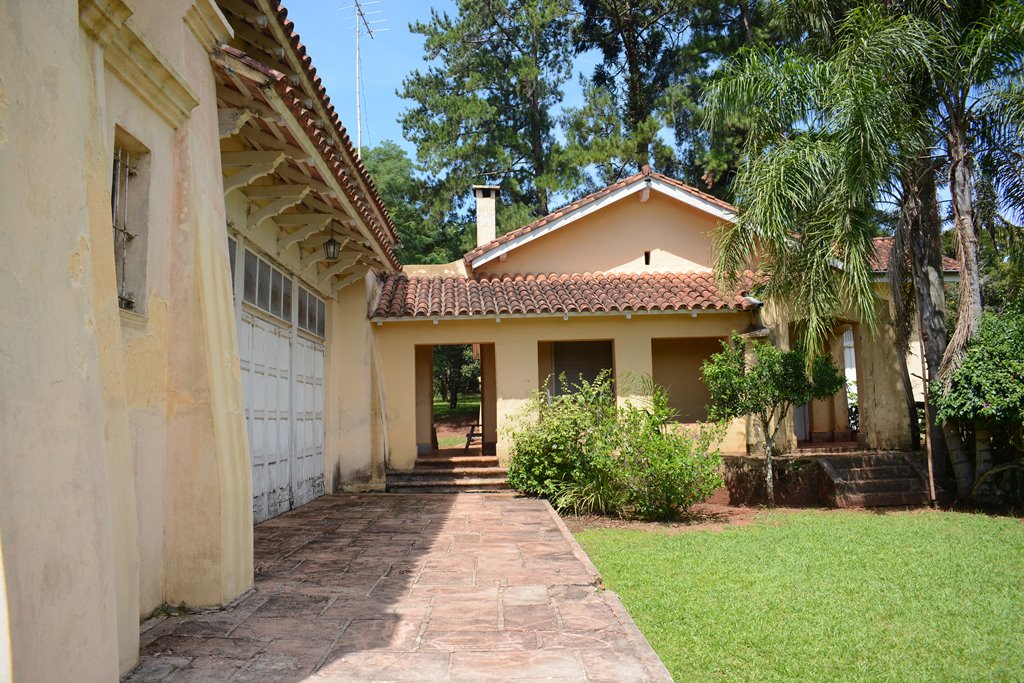
Para familias, amigos y reuniones corporativas; Pristine ofrece Pristine Residence Iguazú, la antigua Mansion Bemberg con su historia y vistas sobre el Río Paraná.
Con vistas inigualables a la puesta del sol y sobre el Río Paraná este Pristine Luxury Camp ofrece una experiencia completamente diferente en la Selva Sana Misionera: senderos únicos guiados y autoguiados, e-bikes para recorrer las minas de Piedras Preciosas, el Lago Urugua-i o visitar otros Saltos en las cercanías, además de una navegación exclusiva al salto Yasy, y, claro está, las Cataratas del Iguazú del lado argentino para quienes reservan su estadía de 3 y 4 noches con todo incluido.
La apertura se hará el 1 de septiembre con seis suites y una capacidad de 24 huéspedes.
Mientras que el Pristine Residence, en la mansión Bemberg, tendrá espacio para 12 huéspedes exclusivo para grupos familiares y corporativos.
La estadía mínima recomendada es de 3 a 4 noches para poder recorrer los atractivos de la región: Saltos Yasy, Bella Vista, Urugua-í, río Paraná, lago Urugua-i. Cataratas de Iguazú lado argentino y brasileño, el Hito Tres Fronteras. Pristine Camps Argentina es una sociedad formada por prestigiosos operadores argentinos bajo un concepto 5i (quíntuple impacto) ya que sus propósitos contemplan generar inversiones inmobiliarias-turísticas sustentables, regenerativas, responsables socialmente, inclusivas y rentables; para lo cual han desarrollado la Fundación Pristine, a través de la cual comprometen la creación de 10 m2 de reserva nativa por cada reserva de alojamiento y el Hotel Escuela en Puerto Libertad (desde febrero 2022) para la capacitación gratuita de las comunidades locales y originarias.